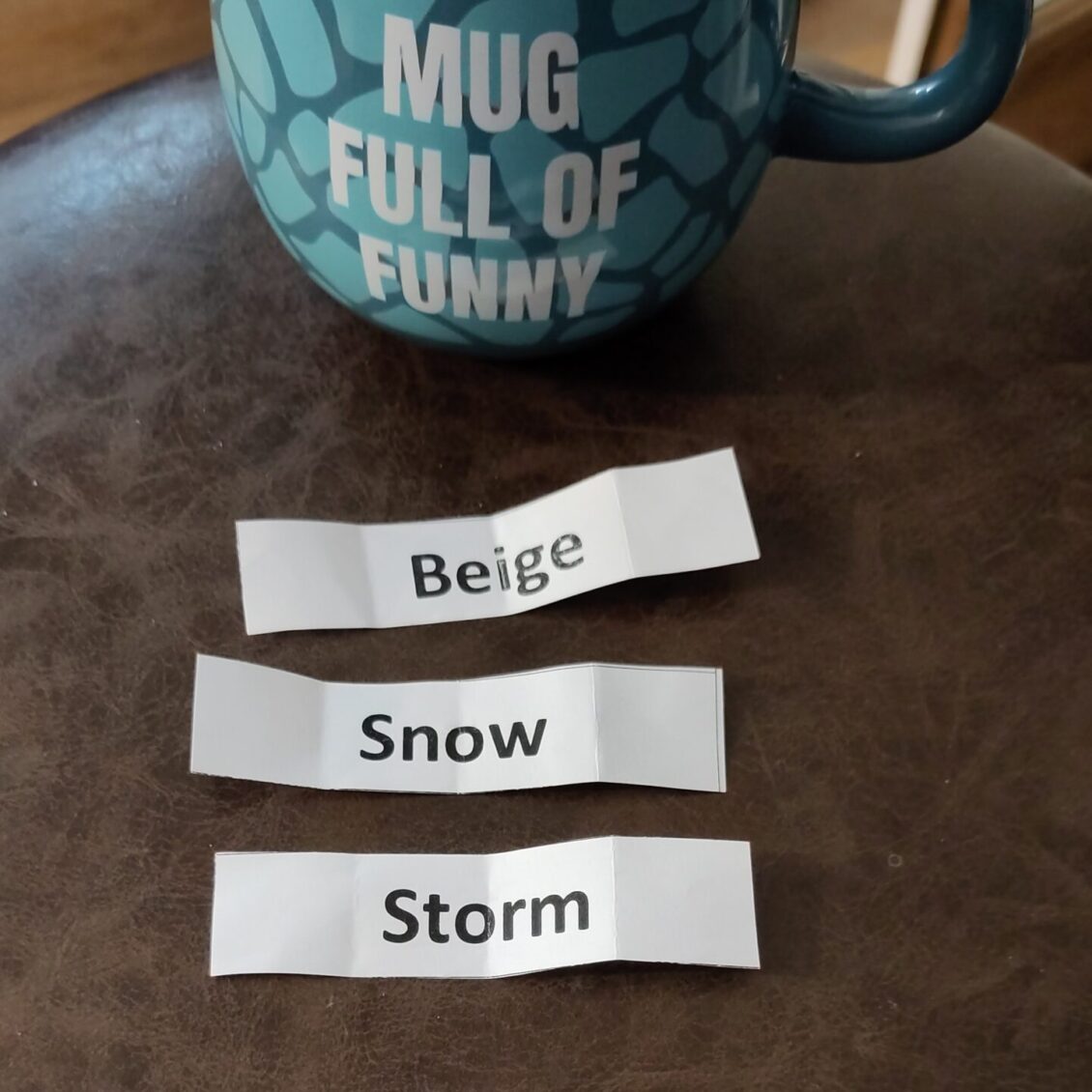
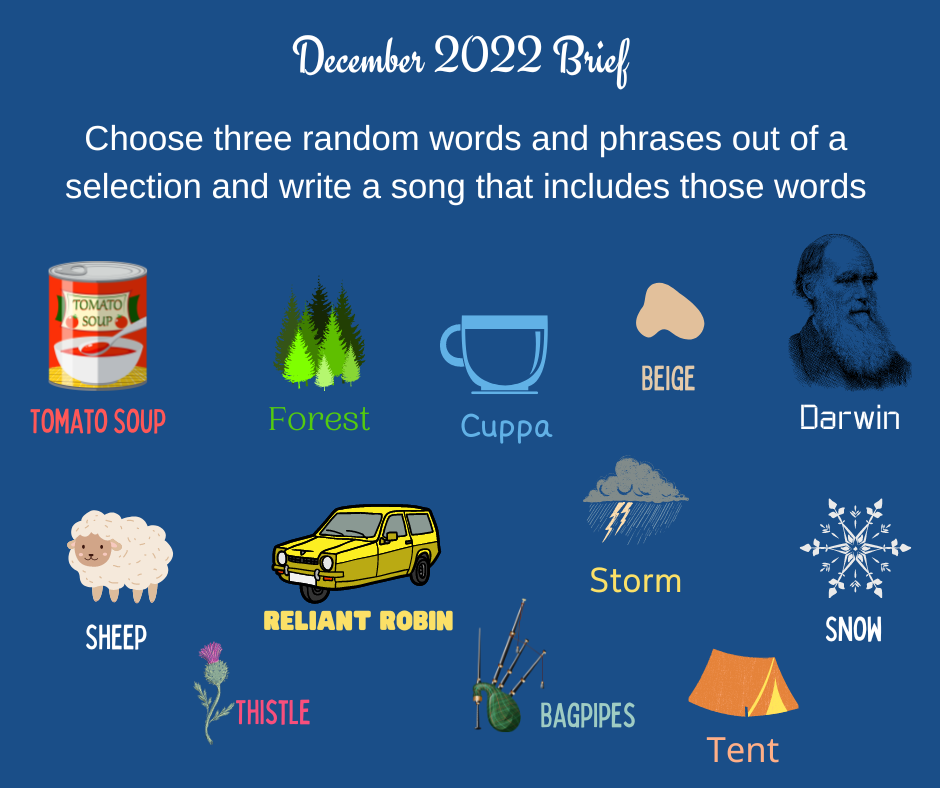
For the first brief of our new group Shrewsbury Songwriters (created to give local songwriters an opportunity to meet each other and share their advice and experiences) I thought I would share something that I was able to try at the students’ Songwriters Society at Falmouth University (brilliantly run by songwriter Ilaina Lowe). The idea is that you randomly choose three words from a selection and write a song including those words. I created my selection and randomly chose my three words, which were Storm, Beige and Snow (I was quite relieved I didn’t get Reliant Robin!). I also thought I would use the opportunity to share and document the creative process behind my songwriting on my blog, which you can read and keep up-to-date with below.
Tag: november

Shrewsbury Songwriters – December 2022
The selection of words
The terrible moment I picked out Beige
I was a bit tired from helping on my sister Becky’s (AKA Daffodowndilly) craft stall at St Mary’s Church in Shrewsbury but thought I would crack out the Bouzouki and spend a few minutes trying to get down some ideas. I’ve started a chorus and managed to use two of my three words (Storm and Snow) in it, with the phrase (and possibly the song title):
“A money snowstorm in a winter wonderland”
My subconscious seems to have a hand on my creative controls – I often don’t know where the words come from and only find the meaning behind my lyrics after I have written them. With this one though, I think it might turn out as a comment on how much throwaway (and often quite expensive) stuff we buy at Christmas, when giving personal cards, messages and meaningful small gifts can be so much more meaningful. Some of the most precious gifts I have been given have not been the most expensive in cash-terms but when it is clear that some thought has gone into its choosing. To me, a personal hand-written card can be worth so much more than an expensive gift.
I think helping at the craft stall today helped to give me the idea for the message behind the song, as looking at all the wonderful designs and hand-made products from the brilliant local independent makers, such as Sister Sister, Eynonymous Designs and of course my sister at Daffodowndilly, reminded me that they were just so much more meaningful than the products advertised on Amazon and other massive online marketplaces and companies.
I’m quite happy with my start on the song and will hopefully be able to build on the chorus in the next few days.
Not much progress today but I did manage to add another line to my chorus, so only another two lines to completely finish the chorus. My mind is already thinking about how I want the finished song to sound like – I’ve discovered and have been listening to Slicer by Kensington and really like the way they double-up the vocals on the chorus, so might look at something similar for my song.
I’ve managed to finish the last two line for the chorus, although I’m not totally sold on them yet, so I might revisit it after I’ve made some progress with the verses. I’ve still got to fit Beige in somewhere, it might involve a sofa…

Songwriters Spotlight – Suphena
Welcome to the latest in the series of weekly blog posts about songwriting, which includes interviews with composers and artists about their views and experiences in this field. This week’s interview is with singer-songwriter Suphena.
Matt:
What is your background in songwriting and performing?
Suphena:
I started performing very early on in the school choir from about the age of 9. I suppose a lot of kids do that sort of thing but then when I reached high school I continued to study music and perform in school concerts. At the age of 18 I bought my first guitar and started learning songs that I liked from YouTube and used the chords I learnt as a basis to write my own songs. I never really finished a lot of songs but the ones I did finish I would play at open mic nights and busk on the streets in Leeds, my hometown, until I realised I wanted to study music at University. This is where I really honed in on my craft and got to a place where my songwriting felt more mature, because I was forced to think more about what I was writing and why.
Matt:
Everyone has different reasons for writing songs, sometimes to express themselves, to tell a story etc. What drives you to write a song and where do you get your inspiration from?
Suphena:
A lot of the time what drives me to write is feeling negative about something, maybe regarding a relationship or a societal issue. In order to process those complex emotions I create music so as to not become destructive. Whatever music I am listening to at the time inspires what I write, but generally Reggae music and Jazz singers are influences which are engrained in me. Right now, I’m listening to lots of Techno and Hip-Hop, so the new EP I am working on will definitely have elements of that creeping in. Also, my Jamaican heritage drives and inspires me too. I’ve always felt somewhat disconnected from that part of myself and when I sing I am reminded of those roots and that plays a big part in my overall identity.
Matt:
It’s really interesting that you use music to express your feelings and emotions, as a lot of other musicians I have spoken to have said they also use it as an outlet. Most art forms seem to be able to be used for expression but music seems to be especially able to do this. I personally can also very much relate to you being influenced by different styles and genres, as I have my Folk side as my main basing but have also been influenced by Pop, EDM and cinematic music. There are often differing views about songs, both on what the most important aspect is and what the most difficult element of a song to compose is. What do you think is the most important part of a song and is there a particular stage of composing that you struggle with?
Suphena:
The most important part of a song to me is the meaning and making sure the music reflects that meaning. Having a clear understanding of what I’m trying to say is first and foremost. If you don’t have a clear message then listeners won’t be able to relate. The most difficult aspect of songwriting for me (at this point in my journey anyway) is structuring. Sometimes I like to stray away from standard Pop structures to make my music more interesting, but then if I stray too far it can become confused and not make sense, so finding a balance can be difficult. I suppose that also has something to do with not wanting to be confined to the genre of pop, too.
Matt:
You mentioned earlier that you are working on an EP, can you tell us more about that and any other projects you’re working on at the moment?
Suphena:
Yeah, I’m in the midst of reworking some older songs of mine and the EP will just showcase what I’ve done so far. It’s the first solo release of mine so I’m very excited! It’s just a stripped back version of my songs with me and my guitar. Another project I’m working on is an EP release and UK tour with my band, Horses on the Beach. And for part of my degree I am working on a techno track, which is really random but challenging!
You can learn more about Suphena and her music by visiting her Facebook, Instagram and SoundCloud pages

Songwriters Spotlight – Jack Ferry
(Main image photo by @facialcavity)
Welcome to the latest in the series of weekly blog posts about songwriting, which includes interviews with composers and artists about their views and experiences in this field. This week’s interview is with singer-songwriter and multi-instrumentalist Jack Ferry.
Matt:
What is your background in songwriting and performing?
Jack:
Well, I’ve been playing in bands for ages now, since I was about 11 now, I think? I started playing keyboards for a band called “No Tributes” that basically did nothing, before playing with a load of other bands with terrible names. Here are my favourite terrible names:
- To Kill A Thunderbird
- Shatter Resistant
- 60 Decisions
- Coldshoulder
- Blunderbuss
- The Restless Kings
- Jessica Rabbit and The Hillbillies
I think the first song I ever wrote was a song called “Mr. E”, which I still think was a very clever name for a song, even if the execution wasn’t as good as I’d like. I’d always made up songs and little poems and ditties and things like that, but when I was 13 or 14 I got really serious about it. I wrote a couple of songs back then that are still in my set to this day, but my first big and good song was my song “I Don’t Know What I’m Doing With My Life”, which I eventually recorded. I’ve rewritten it since, but it still rings true to me. Since then, I’ve written loads and loads of songs; some good, quite a few stinkers, but I’ve always got something to say when it’s put to a tune.
Matt:
Everyone has different reasons for writing songs, sometimes to express themselves, to tell a story etc. What drives you to write a song and where do you get your inspiration from?
Jack:
Honestly, it just sort of happens? If I’m angry about something, or I need to say something, a song helps. But you know, crying publicly is something I’m not very good at, which is where a song comes in. It’s really just an excuse for me to be upset or angry or happy or wistful or whatever really, but very loudly.
Honestly, I think I just like shouting but I’m very shy. Most of my songs come from relationships with people, I don’t really write about things in the news or current events or anything. I think the closest I’ve ever come to that is a song I wrote called “2012” about the idea of the Mayan Apocalypse and how the end of the world didn’t really change anything about the way we interact with each other. But even then, that was very internal and about regrets. I think that if you’re writing about someone or something else, you really are writing about yourself – or how that reflects on yourself

(photo by Denise Ashwin)
Matt:
One thing that has been mentioned by songwriters since this blog series has started has been that they use writing songs to express feelings and emotions that they would struggle to otherwise, so your comments on this are really interesting. I know you play several different instruments, which one(s) do you particularly like writing songs with and what do you think makes them so effective?
Jack:
They all kind of make me write in different ways, I kind of am drawn to the stereotypical songs that you associate with the instruments when I write. When I write on the banjo or the accordion, they always come out more folky. I always seem to talk about nature on the songs I play banjo on, like in my song “Thirty One-Years”, I start talking about yew trees and poison ivy, and using old fashioned words like “sepulchre” and “mausoleum”. Piano gets me all sad and wistful and emotional. Guitar is a wildcard – could be a folky ballad, could be a mid-tempo rocker. Bass always ends up funky. Saxophone always goes ballady and jazzy.
You know, the banjo is actually an instrument from West Africa. But because of the contexts we hear the banjo in, it’s always a southern American folk instrument to us. It’s really difficult to unlearn this and loads of bands I love have managed to do it – They Might Be Giants with the accordion, and X-Ray Spex with the sax – but I’m still working on it. All my accordion songs are probably going to sound like depressing sea shanties for a while.
Matt:
There are often differing views about songs, both on what the most important aspect is and what the most difficult element of a song to compose is. What do you think is the most important part of a song and do you struggle with a particular stage of composing?
Jack:
I struggle with the whole thing! It’s proper difficult! The hardest part when you’re a songwriter is just getting started really. There’s always a worry that I’m not going to write anything as good as I have done in the past. That it’s going to be hacky and not as clever as the stuff I’ve written before. How can I say what I want to say, without just SAYING it? And then outside of just writing lyrics, I always betray myself by not letting myself just pick easy chords. It’s like, there’s millions of FANTASTIC songs that are just I-VI-IV-V, it’s not giving up to just do that, but obviously after you go through three years of music school and learning about arrangements, re-harmonisation, and how to step out of your comfort zone, and all of a sudden I-VI-IV-V is a cowards way out! But really it isn’t. Chords are really just the bones of the songs – as long as they aren’t broken, the song’s going to be fine.
I find the feeling of the song is the most important thing to capture, and it’s the hardest as well. This is why I find myself writing sad lyrics to really upbeat melodies and chord sequences, it’s almost like saying “I’m only pretending to be happy, this is how I feel, but I’m an adult and I have to lie!!!” But then you can’t write a love song to a funeral march and mean it – unless you’re really trying to say that your love is dead. Maybe someone else could. I really just try to create the right ambience, like a host at the w****est dinner party of all time.

(photo by Izaak Spencer)
Matt:
You’ve not only formed several bands, you’ve also played in other musician’s bands as well. Having experience of both “worlds”, what do you enjoy and dislike about both and what projects are you currently working on?
Jack:
Oh, I love being a side-man, y’know? I love having the opportunity to play around in someone else’s world, step into somewhere I normally wouldn’t. Last year, I played bass for a country band called Jasper and The Island and it just gave me a whole new understanding of the bass and how I interact with it, and how I interact with a band setting. It’s nice to not have to be the most entertaining person on stage as well, just for a bit. Don’t get me wrong, I need the attention, but stepping back from time to time is very much needed.
At the moment, I’m working on my first solo album with my brilliant band. I’m also playing keyboards, accordion, saxophone, penny whistle, and backing vocals for William Grant. I’m trying to keep as busy as I can with music at the moment, graduate life is a killer.
You can learn more about Jack and his music by visiting his website at www.jackferrythemusician.com/music and Facebook page. His EP “Polite Pop” is available to listen to and purchase on many digital music platforms, including Spotify, Amazon, iTunes and Bandcamp
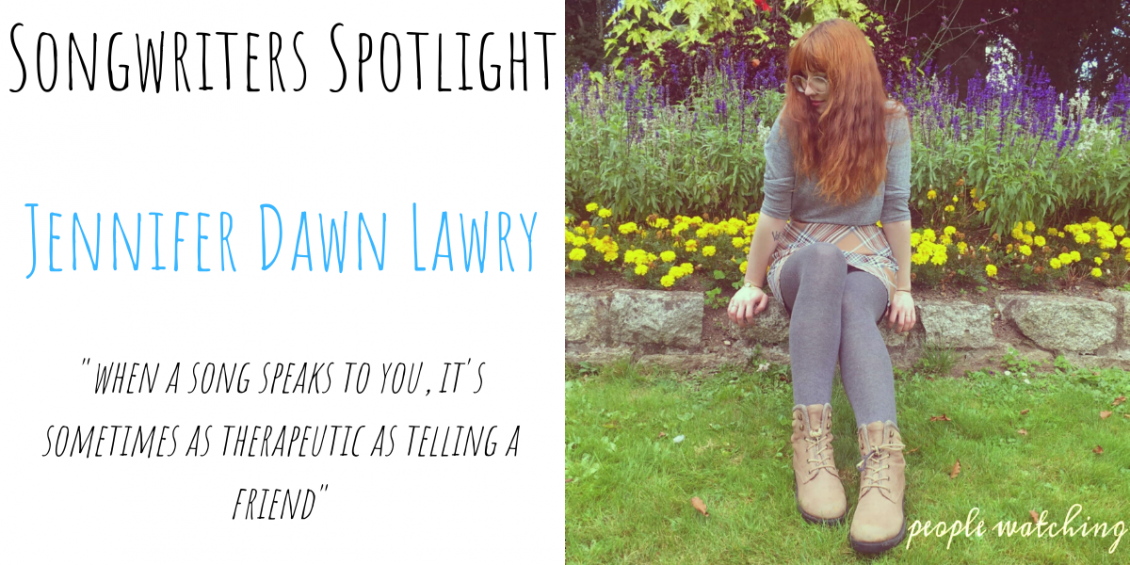
Songwriters Spotlight – Jennifer Dawn Lawry
Welcome to the latest in the series of weekly blog posts about songwriting, which includes interviews with composers and artists about their views and experiences in this field. This weeks interview is with Yorkshire singer-songwriter Jennifer Dawn Lawry.
Matt:
What is your background in songwriting and performing?
Jennifer:
I’ve been songwriting since I was 11 but it was very Avril Lavigne which is super embarrassing haha, but my granddad inspired me to perform. He was in a male Voice choir and was an amazing singer so I kinda wanted to follow in his footsteps. I just got obsessed with music from then on!
Matt:
Everyone has different reasons for writing songs, sometimes to express themselves, to tell a story etc. What drives you to write a song and where do you get your inspiration from?
Jennifer:
I used to get inspiration from trauma and stuff I couldn’t deal with. Abuse is a weird thing to process so writing songs allowed me to release all I was feeling without straight up saying it. Now though I mostly write about growth and stuff around me. Being an older soul is kinda weird because I’m not too exciting I guess but my songs end up sounding calming haha
Matt:
It sounds like music has been really healing and helpful for you during some very dark times. Do you feel that music, whether playing, listening or writing, could be used to help people get through difficult periods in their life?
Jennifer:
Yeah I do! Music can translate feelings that we can’t explain very well. Being mentally ill is hard when you’re not sure how to explain a lot of your issues but when a song speaks to you, it’s sometimes as therapeutic as telling a friend.
Matt:
There are often differing views about songs, both on what the most important aspect is and what the most difficult element of a song to compose is. What do you think is the most important part of a song and do you struggle with a particular stage of composing?
Jennifer:
I’ve never been the best at instrumental composition. I struggle to finger pick a guitar so I default to chords most of the time. But when I listen to music myself, I find that the melody (vocally and instrumentally) is my favourite part and the part that sometimes drives the emotion more than the lyrics
Matt:
What projects are you currently working on and where can we find out more?
Jennifer:
I’m currently in my first semester of my master’s degree so I’m being very diligent with my education and my new job. However I’m hoping to be releasing more music over the next year on my SoundCloud dawnmusicfalmouth
You can learn more about Dawn and her music by visiting her SoundCloud and Facebook pages and can purchase her music from her BandCamp page.
You must be logged in to post a comment.