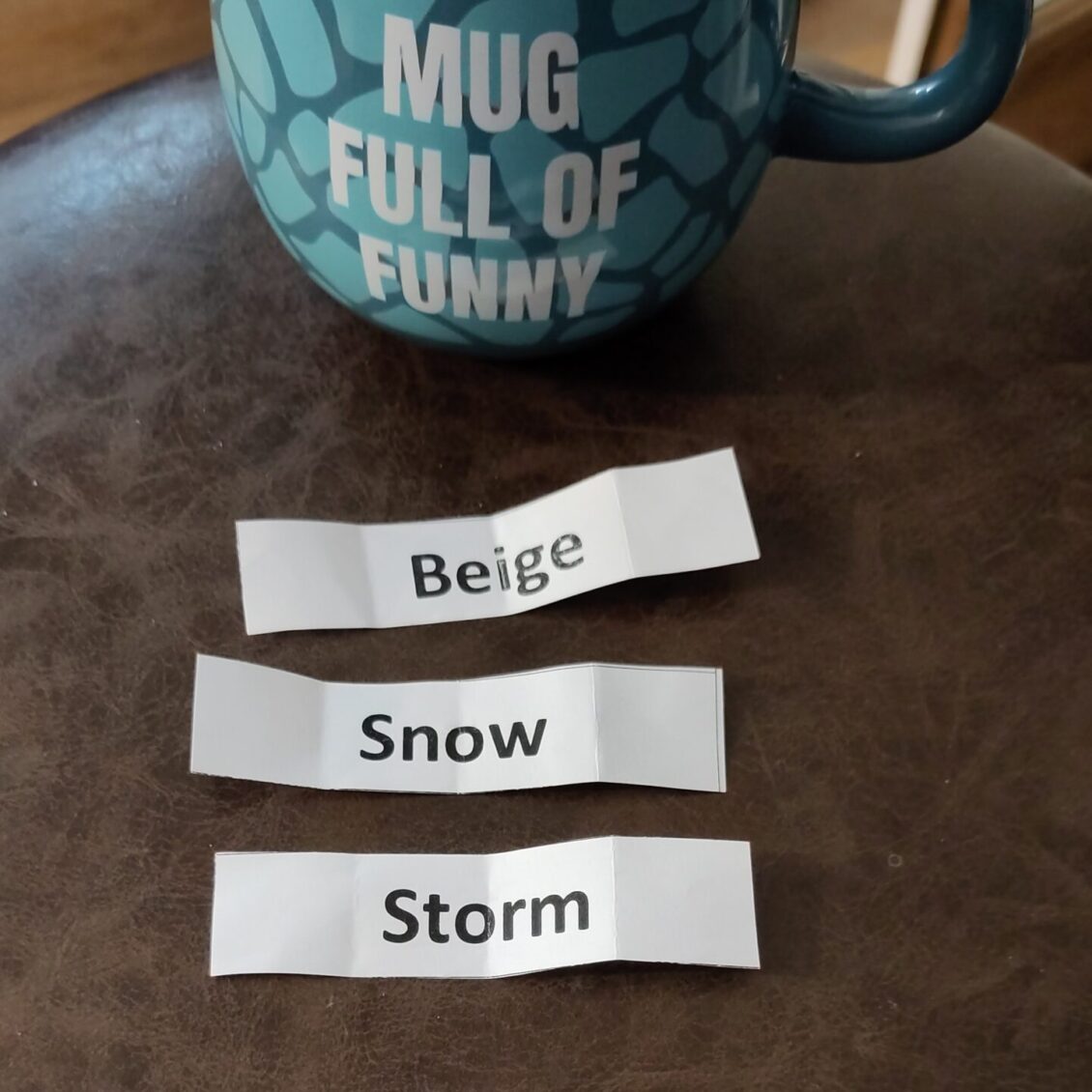
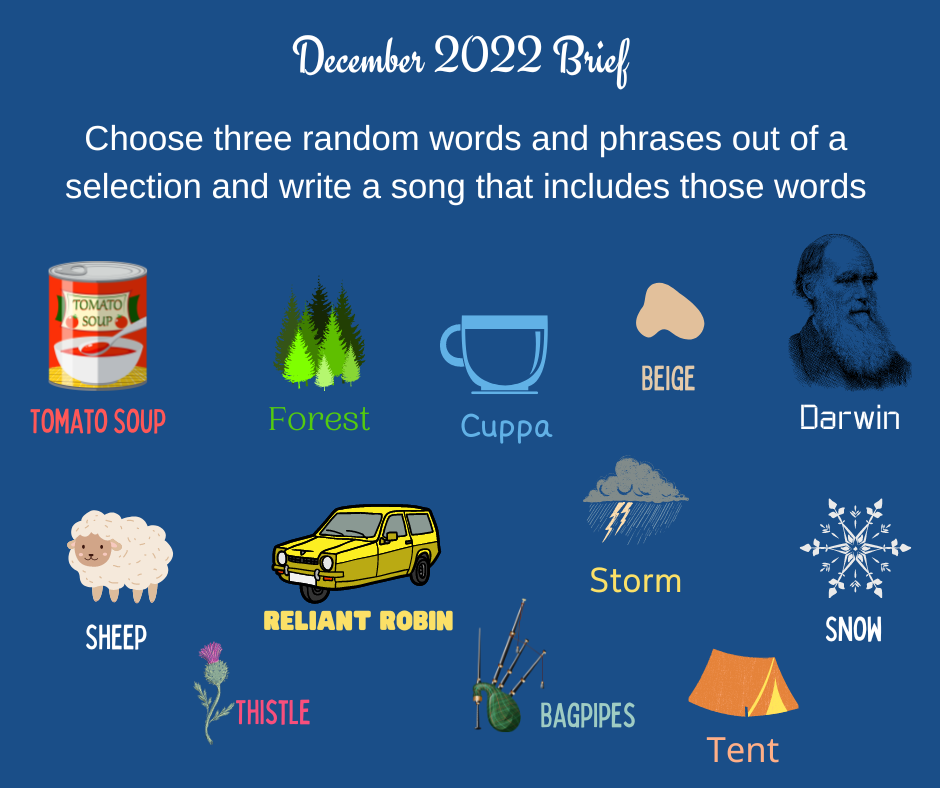
For the first brief of our new group Shrewsbury Songwriters (created to give local songwriters an opportunity to meet each other and share their advice and experiences) I thought I would share something that I was able to try at the students’ Songwriters Society at Falmouth University (brilliantly run by songwriter Ilaina Lowe). The idea is that you randomly choose three words from a selection and write a song including those words. I created my selection and randomly chose my three words, which were Storm, Beige and Snow (I was quite relieved I didn’t get Reliant Robin!). I also thought I would use the opportunity to share and document the creative process behind my songwriting on my blog, which you can read and keep up-to-date with below.
Tag: december

Shrewsbury Songwriters – December 2022
The selection of words
The terrible moment I picked out Beige
I was a bit tired from helping on my sister Becky’s (AKA Daffodowndilly) craft stall at St Mary’s Church in Shrewsbury but thought I would crack out the Bouzouki and spend a few minutes trying to get down some ideas. I’ve started a chorus and managed to use two of my three words (Storm and Snow) in it, with the phrase (and possibly the song title):
“A money snowstorm in a winter wonderland”
My subconscious seems to have a hand on my creative controls – I often don’t know where the words come from and only find the meaning behind my lyrics after I have written them. With this one though, I think it might turn out as a comment on how much throwaway (and often quite expensive) stuff we buy at Christmas, when giving personal cards, messages and meaningful small gifts can be so much more meaningful. Some of the most precious gifts I have been given have not been the most expensive in cash-terms but when it is clear that some thought has gone into its choosing. To me, a personal hand-written card can be worth so much more than an expensive gift.
I think helping at the craft stall today helped to give me the idea for the message behind the song, as looking at all the wonderful designs and hand-made products from the brilliant local independent makers, such as Sister Sister, Eynonymous Designs and of course my sister at Daffodowndilly, reminded me that they were just so much more meaningful than the products advertised on Amazon and other massive online marketplaces and companies.
I’m quite happy with my start on the song and will hopefully be able to build on the chorus in the next few days.
Not much progress today but I did manage to add another line to my chorus, so only another two lines to completely finish the chorus. My mind is already thinking about how I want the finished song to sound like – I’ve discovered and have been listening to Slicer by Kensington and really like the way they double-up the vocals on the chorus, so might look at something similar for my song.
I’ve managed to finish the last two line for the chorus, although I’m not totally sold on them yet, so I might revisit it after I’ve made some progress with the verses. I’ve still got to fit Beige in somewhere, it might involve a sofa…

Fiddler Players That Are Amazing- Part 1
Over the years playing Fiddle, I have been (and still am) influenced by many different Fiddle players. Their style of playing, techniques and composition and improvisation methods all add to and make up each musician’s unique sound. In the first of this two-part blog, I would like to share with you some of these amazing musicians who may well influence your sound too.
Phil Beer

An amazing Fiddle player and accomplished with sound engineering, Phil Beer cites his main instrument as the Guitar. I am reminded of a Guitar workshop I attended, led by Phil Beer at Sidmouth Folk Festival several years ago, where he said that he wouldn’t call himself a Fiddle player, which completely bemused me at the time, as his skill with the Fiddle was incredible.
As a founder of the Folk group Show of Hands, this Devonshire Fiddler has played at huge venues and festivals, including multiple performances at the Royal Albert Hall and the BBC Folk Awards. He is also a skilled solo performer and has performed with his band The Phil Beer Band for many years.
Beer has been and still is one of my Fiddle idols, inspiring me with his innovative and soulful Fiddle playing and rich vocals, combined with his skilled use of reverb, delay, EQ and other effects. This man has very much shaped my musical development.
Phil Beer’s Website: www.philbeer.co.uk
Show of Hands Website: www.showofhands.co.uk
Nancy Kerr

Renowned both individually and as a duo with her husband James Fagan, Nancy Kerr is a very experienced and popular musician. Her Fiddle playing is a mixture of different styles, including Scottish and Irish, with techniques such as Scottish snaps, twiddles and twirls playing a prominent role in many tunes, which can be seen in her performance of Dance to Your Daddy.
In addition to her Fiddle skills, she is a talented singer and has performed and recorded many different songs. She is also very talented at singing and playing the Fiddle at the same time, which is something I’m still working on and I have great respect for anyone who is able to do this! Kerr has released several albums with Fagan and one solo album, while winning several awards, including BBC Radio 2’s Folk Singer of The Year and Best Duo awards for her and James Fagan’s collaborations.
Website: https://nancykerr.co.uk
Sam Sweeney

Sam Sweeney has had a very successful career, being a member of several Folk bands including the hugely successful Folk collective Bellowhead (which he left University to join!) and the band Leveret (with Rob Harbron and Andy Cutting). He has also collaborated with several other Folk artists, including Hannah James and Eliza Carthy.
His versatile Fiddle playing seems to be very much influenced by Scottish Fiddle music, featuring snaps and snatches. From slow, beautifully resonant Waltzes to powerful and fast-paced Bellowhead numbers, Sweeney seems to have the ability to turn his bow to whatever is the required energy of the piece.
In addition to his band work, he won the 2015 BBC Radio 2 Folk Award’s Musician of the Year, released his second solo album Unearth Repeat in 2020 and is currently offering Fiddle lessons via Zoom. As another one of my Fiddle idols, I’m very excited to see what Sam Sweeney’s next project is!
Website: www.samsweeneymusic.com
Brittany Haas

I came across Californian Fiddler Brittany Haas when I saw her performing as a member of the American Folk group Crooked Still, in the very early days of the Shrewsbury Folk Festival (after it moved from Bridgnorth). I was really taken by her Fiddle style, which seems to incorporate techniques from Cajun and Scottish music as well as elements from what I would describe as Nordic Fiddle. These elements all form into a really beautiful style that sounds brilliant for both slow, melodic pieces and rip-roaring, barn dance-style tunes.
Haas has performed at festivals and venues across the world, also performing at Late Night With David Lettermen. She has also collaborated with and been a part of many different musicians and groups, such as Crooked Still and Steve Martin’s Bluegrass Band, as well as recording her own albums and performing with her quartet Hawktail.
Website: www.brittanyhaas.com
Summary
Look out for the second part of Fiddle Players That Are Amazing, which will feature another four amazing musicians! To make sure you don’t miss any of my blog articles, you can subscribe to my newsletter using one of the forms on the website.
You can also listen to music from all the musicians in this series in the Spotify playlist for this blog, which you can find here.

Songwriters Spotlight – J Bravo
(Main photo by Samad Parvez)
Welcome to the latest in the series of weekly blog posts about songwriting, which includes interviews with composers and artists about their views and experiences in this field. This week’s interview is with Leeds musician, songwriter and rapper J Bravo.
Matt:
What is your background in songwriting and performing?
J Bravo:
I started performing when I was 9 years old, I spent my teenage years participating in community cast and chorus line groups for plays that were held at The West Yorkshire Playhouse. At around age 13 I discovered “Real Hip Hop”, I would stop and start the songs line by line and write the words down to learn what the MC’s were saying. Eventually I started writing my own rhymes.
Matt:
Everyone has different reasons for writing songs and lyrics, sometimes to express themselves, to tell a story etc. What drives you to write a song and where do you get your inspiration from?
J Bravo:
The second part is easier to answer first: other fantastic songs or even movies. In particular, The Wu Tang Forever album and the first Matrix film made me think a lot about how I would want to hold a concept throughout a body of work. I guess what drives me to write a song is the necessity for a particular subject to be addressed, I spend more time jotting down topics for songs and waiting for a really cool or poignant phrase, or the right beat, that I can build upon.
Matt:
You were part of making the music and rap video Who’s To Blame, which was part of a campaign to promote awareness of and fight against weapons on the streets. Do you feel songs (and particularly Rap) are a good platform to use for these types of issues?
J Bravo:
I do, a lot of songs that touched on these subjects that I grew up on were important because they were from our perspective, as opposed to assumptions and conclusions made solely from outside media sources. “Who’s To Blame?” was written to try address back then what has become “Cancel Culture” today.

(Photo by Samad Parvez)
Matt:
Rap has become very common in current chart and Pop music. Compared to rappers perhaps not as widely known, what are your thoughts about the quality of rappers in the charts, their music and the meaning behind their lyrics?
J Bravo:
Without going into a tirade about mumble rap, I think the main problem is that the demand for rappers to be acclaimed lyricists in order to be successful has diminished, the bar has been set so low. Even Jay Z’s latest work, I feel he hasn’t had to push himself to be the best he can be since 2004, because in the mainstream market today the consumer is lenient and wordplay is treated more like a trademark than a required trait. you hear all the time now “Kendrick Lamar is one of them lyrical rappers” but it’s said as if it’s optional, as if you don’t NEED lyrics to be a rapper.
Matt:
There are often differing views about songs, both on what the most important aspect is and what the most difficult element of a song to compose is. What do you think is the most important part of a song and do you struggle with a particular stage of composing?
J Bravo:
I find catchiness the hardest part to writing songs. I’m not good with repetition and recurring phrases, I lose faith in keeping the audience’s interest with things like that in my songs. It’s a big reason why I like to collaborate with other MC’s often, we help each other build on the things we are less skilled at doing.
Matt:
What projects and songs are you working on at the moment?
J Bravo:
I am working on an album called “Chapeltown Bread” and I have nearly finished a collaborative project with DJ Agent M. I am really excited to see how people feel about my next pieces of work.
You can learn more about J Bravo and his music by visiting his Facebook page and can listen to his music at BandCamp and Spotify

Songwriters Spotlight – Harry Glasson
Welcome to the latest in the series of weekly blog posts about songwriting, which includes interviews with composers and artists about their views and experiences in this field. This week’s interview is with Cornish singer-songwriter Harry Glasson, who has written an incredible wealth of songs.
Matt:
What is your background in songwriting and performing?
Harry:
I made an acoustic guitar in woodwork class at school, it was not great but it played. I joined the Merchant Navy and took the Guitar with me and swapped it for a transistor radio on leaving my first ship. A couple of years later I met and worked with a lad who has become a lifelong friend and fellow singer/songwriter Jonathon Ryan. He already had a Guitar so I got me one too, an EKO as I remember, like playing a railway sleeper with strings on. We performed at parties and later at the local pub and the performing just sort of grew from there.
Matt:
Everyone has different reasons for writing songs, sometimes to express themselves, to tell a story etc. What drives you to write a song and where do you get your inspiration from?
Harry:
From as far back as I can remember I have loved to read and as a kid I read anything and everything. I grew up the eldest of a family of eight my father was mainly on agricultural wages and liked a drink, so buying books, even borrowing books was not easy. So, I wrote things, little bits and pieces and enjoyed condensing these stories down into poems and eventually songs. Living here in Cornwall it is not difficult to get inspired as we have the history, the beauty, legend and culture at a fingers touch. The men have dug underground here since at least Roman times for the tin and copper. Sailors have navigated our miles of coastline, including the smuggling of contraband. We have the standing stones, stone circles and the villages of prehistory. The legends of King Arthur, Merlin, giants and piskys, all set in wonderful rugged landscape. Who can fail to be inspired?

Matt:
There are often differing views about songs, both on what the most important aspect is and what the most difficult element of a song to compose is. What do you think is the most important part of a song and do you struggle with a particular stage of composing?
Harry:
I think the most important part of a song is getting it real, truthful and as accurate as possible. I have usually found that the initial lines drawn from inspiration come easily, the hard work is fleshing out the story around them within the confines of the arrangement.
Matt:
You’ve composed a large collection of Folk songs about Cornwall, which have been performed and adopted by many artists, both Cornish and wider-a-field, including The Harry Glasson Project organised by Will Keating. It feels like these songs have become a significant part of Cornwall’s musical heritage. Where do you feel Cornish Folk music and perhaps Folk music in general is heading towards?
Harry:
I think it was Woody Guthrie who said, “as long as there are disasters, wrong doings and a man wants to woo a woman, there will always be folk music” and I do believe he was right. There has been a big resurgence in pub singing here in Cornwall this last few years which is a form of Folk music. Pub singing, people with a glass in hand singing unconducted, usually in three-part harmony. For some reason my songs have appealed to this form of singing especially and has carried over to the Guitar playing folk singing in the clubs. The Cornish music scene is vibrant these days.
Matt:
What projects and compositions are you working on at the moment?
Harry:
At the moment I am working on putting a song book together, it is in its infancy but a good start has been made. Will Keating is planning a new album for next year so we are getting together on that one too, some new material has been created but needs some honing and no release date has been set.
You can learn more about Harry’s beautiful songs by joining the Facebook page Harry (Safari) Glasson’s Music where you can see other musicians performing his songs and chat about his lyrics. His songs are also currently being performed by singer-songwriter Will Keating, who you can learn more about by visiting his website and Facebook page.

Songwriters Spotlight – Lunacci
(Main image photo by Lauren Norris)
Welcome to the latest in the series of weekly blog posts about songwriting, which includes interviews with composers and artists about their views and experiences in this field. This week’s interview is with songwriter, performer and composer Lunacci (pronounced loo-nah-see).
Matt:
What is your background in songwriting and performing?
Lunacci:
I started writing songs at the age of about 6 years old, I had a copy of Sony Acid 2.0 (some old music software), and I used to just drag the pre-recorded loops around…. it sounded terrible, but I learnt a lot about song writing at a young age because of it. I guess my first ‘performances’ came through church. I started playing drums with the church band from the age of 11. I think it taught me a lot about band etiquette and musical sensitivity.

(Photo by Lauren Norris)
Matt:
Everyone has different reasons for writing songs, sometimes to express themselves, to tell a story etc. What drives you to write a song and where do you get your inspiration from?
Lunacci:
I’m driven by the need to express myself, which I don’t pretend is anything unique. I think we all need outlets to express ourselves, and they can take many different forms, but mine is music and lyrics. Probably unsurprisingly, my biggest inspiration are the people I interact with. Sometimes I write about people that I meet for just a few fleeting moments, but 90% of my songs are about my friends.
Matt:
There are often differing views about songs, both on what the most important aspect is and what the most difficult element of a song to compose is. What do you think is the most important part of a song and do you struggle with a particular stage of composing?
Lunacci:
I think the most important part of a song is how it makes the listener feel, which is weirdly often overlooked. I see a lot of bands and musicians making music that is ‘cool’ or ‘well-written’ but having either little or the wrong emotional impact. Most of my music is very simple, I don’t pretend it’s anything fancy, but I do think it’s pretty clear how it’s meant to make you feel.

(Photo by Chris Trevena)
Matt:
In addition to your performances as Lunacci, you’ve done several different musical projects in the last few years, including composing cinematic music and session work. What have been the good and bad moments of these and how have your different experiences influenced your songwriting?
Lunacci:
I do work on other projects, most of the time they are entirely different, but sometimes they interlink… I once used an instrumental version of one of my Lunacci songs for a documentary.
Matt:
You started your Lunacci performances as a solo act but in the last few years you’ve developed into a band (named Lunacci + The Lunatics). Has this expanded the possibilities for your compositions and what projects are you currently working on?
Lunacci:
Yeah, I had always planned on expanding into a band, so it was nice when that happened. Working with a collective of musicians means there is a lot more potential for more complex musicality, I think that’s something I’m still discovering. Currently we’ve let things have a little bit of a rest, we had a manic past few years and all the gigs over the summer really tired me out. I’m using the time to write new material so that things will feel nice and fresh come the new year.
You can learn more about Lunacci + The Lunatics and their music by visiting their website at www.lunacci.co.uk and Facebook, Twitter and YouTube pages. Their music is available to listen to and purchase on many digital music platforms, including Spotify and CDBaby
You must be logged in to post a comment.